LOCKMANAYA BAL GANGA DHAR TILAK
Bal Gangadhar Tilak
Bal Gangadhar Tilak (or Lokmanya Tilak, ) 23 July 1856 – 1 August 1920), born as Keshav Gangadhar Tilak, was an Indian nationalist, teacher, and an independence activist. He was one third of the Lal Bal Pal triumvirate. Tilak was the first leader of the Indian Independence Movement. Bal Gangadhar Tilak. Jump to navigation Jump to search. Bal Gangadhar Tilak (or Lokmanya Tilak, pronunciation ; 23 July 1856 – 1 August 1920), born as Keshav Gangadhar Tilak, was an Indian nationalist, teacher, and an independence activist. He was one third of the Lal Bal Pal triumvirate.
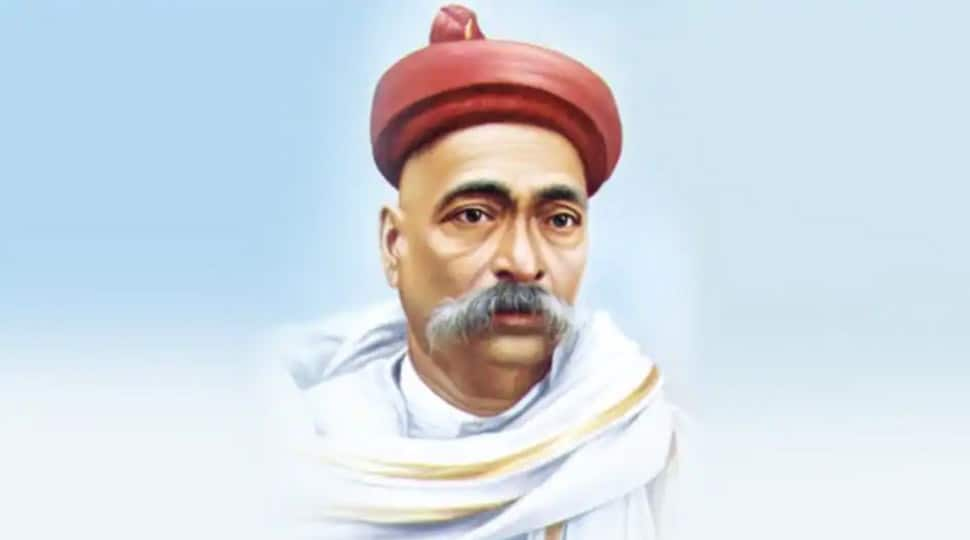
- Bal Gangadhar Tilak (or Lokmanya Tilak, pronunciation (help · info); 23 July 1856 – 1 August 1920), born as Keshav Gangadhar Tilak, was an Indian nationalist, teacher, and an independence activist. He was one third of the Lal Bal Pal triumvirate. Tilak was the first leader of the Indian Independence Movement. The British colonial authorities called him "The father of the Indian unrest."
- Bal Gangadhar Tilak (or Lokmanya Tilak, pronunciation (help · info) ; 23 July 1856 – 1 August 1920), born as Keshav Gangadhar Tilak, was an Indian nationalist, teacher, and an independence activist. He was one third of the Lal Bal Pal triumvirate. Tilak was the first leader of the Indian Independence Movement.
Early life
Keshav Gangadhar Tilak was born on 23 July 1856 in an Indian Marathi Hindu Chitpavan Brahmin family in Ratnagiri, the headquarters of the Ratnagiri district of present-day Maharashtra (then Bombay Presidency).[1] His ancestral village was Chikhali. His father, Gangadhar Tilak was a school teacher and a Sanskrit scholar who died when Tilak was sixteen. In 1871 Tilak was married to Tapibai (Née Bal) when he was sixteen, a few months before his father's death. After marriage, her name was changed to Satyabhamabai. He obtained his Bachelor of Arts in first class in Mathematics from Deccan College of Pune in 1877. He left his M.A. course of study midway to join the LL.B course instead, and in 1879 he obtained his LL.B degree from Government Law College . After graduating, Tilak started teaching mathematics at a private school in Pune. Later, due to ideological differences with the colleagues in the new school, he withdrew and became a journalist. Tilak actively participated in public affairs. He stated: "Religion and practical life are not different. The real spirit is to make the country your family instead of working only for your own. The step beyond is to serve humanity and the next step is to serve God.
Political career
Tilak had a long political career agitating for Indian autonomy from the British rule. Before Gandhi, he was the most widely known Indian political leader. Unlike his fellow Maharashtrian contemporary, Gokhale, Tilak was considered a radical Nationalist but a Social conservative. He was imprisoned on a number of occasions that included a long stint at Mandalay. At one stage in his political life he was called "the father of Indian unrest" by British author Sir Valentine Chirol.
Indian National Congress
Tilak joined the Indian National Congress in 1890. He opposed its moderate attitude, especially towards the fight for self-government. He was one of the most-eminent radicals at the time. In fact, it was the Swadeshi movement of 1905–1907 that resulted in the split within the Indian National Congress into the Moderates and the Extremists.
Tilak opposed the moderate views of Gopal Krishna Gokhale, and was supported by fellow Indian nationalists Bipin Chandra Pal in Bengal and Lala Lajpat Rai in Punjab. They were referred to as the "Lal-Bal-Pal triumvirate". In 1907, the annual session of the Congress Party was held at Surat, Gujarat. Trouble broke out over the selection of the new president of the Congress between the moderate and the radical sections of the party. The party split into the radicals faction, led by Tilak, Pal and Lajpat Rai, and the moderate faction. Nationalists like Aurobindo Ghose, V. O. Chidambaram Pillai were Tilak supporters.
Life after Mandalay
 This article needs additional citations for verification. (August 2019) (Learn how and when to remove this template message)
Tilak developed diabetes during his sentence in Mandalay prison. This and the general ordeal of prison life had mellowed him at his release on 16 June 1914. When World War I started in August of that year, Tilak cabled the King-Emperor George V of his support and turned his oratory to find new recruits for war efforts. He welcomed The Indian Councils Act, popularly known as Minto-Morley Reforms, which had been passed by British Parliament in May 1909, terming it as "a marked increase of confidence between the Rulers and the Ruled". It was his conviction that acts of violence actually diminished, rather than hastening, the pace of political reforms. He was eager for reconciliation with Congress and had abandoned his demand for direct action and settled for agitations "strictly by constitutional means" – a line that had long been advocated by his rival Gokhale. Tilak reunited with his fellow nationalists and rejoined the Indian National Congress during the Lucknow pact 1916.
Thoughts and views
Religio-Political Views
Tilak sought to unite the Indian population for mass political action throughout his life. For this to happen, he believed there needed to be a comprehensive justification for anti-British pro-Hindu activism. For this end, he sought justification in the supposed original principles of the Ramayana and the Bhagavad Gita. He named this call to activism karma-yoga or the yoga of action. In his interpretation, the Bhagavad Gita reveals this principle in the conversation between Krishna and Arjuna when Krishna exhorts Arjuna to fight his enemies (which in this case included many members of his family) because it is his duty. In Tilaks opinion, the Bhagavad Gita provided a strong justification of activism. However, this conflicted with the mainstream exegesis of the text at the time which was predominated by renunciate views and the idea of acts purely for God. This was represented by the two mainstream views at the time by Ramanuja and Adi Shankara.
Social views
Tilak was strongly opposed to liberal trends emerging in Pune such as women's rights and social reforms against untouchability. Tilak vehemently opposed the establishment of the first Native girls High school (now called Huzurpaga) in Pune in 1885 and its curriculum using his newspapers, the Mahratta and Kesari. Tilak was also opposed to intercaste marriage, particularly the match where an upper caste woman married a lower caste man. In the case of Deshasthas, Chitpawans and Karhades, he encouraged these three Maharashtrian Brahmin groups to give up "caste exclusiveness" and intermarry. Tilak officially opposed the age of consent bill which raised the age of marriage from ten to twelve for girls, however he was willing to sign a circular that increased age of marriage for girls to sixteen and twenty for boys. He fully supported social reforms but in his opinion self-rule took precedence over any social reform. On the whole Tilak was not against social reforms. Though he was against the age of consent bill, he arranged his daughter's marriage at the age of fifteen. He also advocated widow marriages. He also congratulated Dhondo Keshav Karve when he married a widow after the death of their first wife. He was in the favour of social reforms but without the interference of British Government.
Esteem for Swami Vivekananda
- "No Hindu, who, has the interests of Hinduism at his heart, could help feeling grieved over Vivekananda's samadhi. Vivekananda, in short, had taken the work of keeping the banner of Advaita philosophy forever flying among all the nations of the world and made them realize the true greatness of Hindu religion and of the Hindu people. He had hoped that he would crown his achievement with the fulfillment of this task by virtue of his learning, eloquence, enthusiasm and sincerity, just as he had laid a secure foundation for it; but with Swami's samadhi, these hopes have gone. Thousands of years ago, another saint, Shankaracharya, who, showed to the world the glory and greatness of Hinduism. At the fag of the 19th century, the second Shankaracharya is Vivekananda, who, showed to the world the glory of Hinduism. His work has yet to be completed. We have lost our glory, our independence, everything."
Social contributions
Tilak started two weeklies, Kesari ("The Lion") in Marathi and Mahratta in English (sometimes referred as 'Maratha' in Academic Study Books) in 1880–81 with Gopal Ganesh Agarkar as the first editor. By this he was recognized as 'awakener of India', as Kesari later became a daily and continues publication to this day. In 1894, Tilak transformed the household worshipping of Ganesha into a grand public event (Sarvajanik Ganeshotsav). The celebrations consisted of several days of processions, music, and food. They were organized by the means of subscriptions by neighbourhood, caste, or occupation. Students often would celebrate Hindu and national glory and address political issues; including patronage of Swadeshi goods. In 1895, Tilak founded the Shri Shivaji Fund Committee for the celebration of "Shiv Jayanti", the birth anniversary of Shivaji, the founder of the Maratha Empire. The project also had the objective of funding the reconstruction of the tomb (Samadhi) of Shivaji at Raigad Fort. For this second objective, Tilak established the Shri Shivaji Raigad Smarak Mandal along with Senapati Khanderao Dabhade II of Talegaon Dabhade, who became the founder President of the Mandal.
Books
In 1903, Tilak wrote the book "The Arctic Home in the Vedas". In it, he argued that the Vedas could only have been composed in the Arctics, and the Aryan bards brought them south after the onset of the last ice age. He proposed a new way to determine the exact time of the Vedas. In "The Orion", he tried to calculate the time of the Vedas by using the position of different Nakshatras. The positions of the Nakshtras were described in different Vedas. Tilak wrote "Shrimadh Bhagvad Gita Rahasya" in prison at Mandalay – the analysis of 'Karma Yoga' in the Bhagavad Gita, which is known to be a gift of the Vedas and the Upanishads.
Descendants
Tilak's son, Shridhar campaigned for social reforms in late 1920s with Dr.Ambedkar.Both were leaders of the multi-caste Samata sangh. Shridhar's son, Jayantrao Tilak (1921–2001) was editor of the Kesari newspaper for many years. Jayantrao was also a politician from the Congress party. He was a member of the Parliament of India representing Maharashtra in the Rajya Sabha, the upper house of the Indian Parliament. He was also a member of the Maharashtra Legislative Council.
Rohit Tilak, a descendant of Bal Gangadhar Tilak, is a Pune-based Congress party politician. In 2017, a woman with whom he had an extra-marital affair accused him of rape and other crimes. He is currently out on bail in connection with these charges.
Legacy
Tilak Smarak Ranga Mandir, a theatre auditorium in Pune is dedicated to him. In 2007, the Government of India released a coin to commemorate the 150th birth anniversary of Tilak. The formal approval of the government of Burma was received for the construction of clafs-cum-lecture hall in the Mandalay prison as a memorial to Lokmanya Tilak. ₹35,000 (US$490) were given by the Indian Government and ₹7,500 (US$110) by the local Indian community in Lokmanya: Ek Yug Purush is a film released on 2 January 2015 based on his life. Directed by Om Raut, Tilak is played by actor Subodh Bhave.


Hallo
ReplyDeleteNice 👌
ReplyDeleteVery nice dear👍👌
ReplyDeleteVery nice compilation, your thoughts presented on Tilak death anniversary was excellent. Keep it up.
ReplyDeleteThank uouuouyso much sir🙏🙏
DeleteSuperb dear 👌
ReplyDeleteThanks dear
Delete